
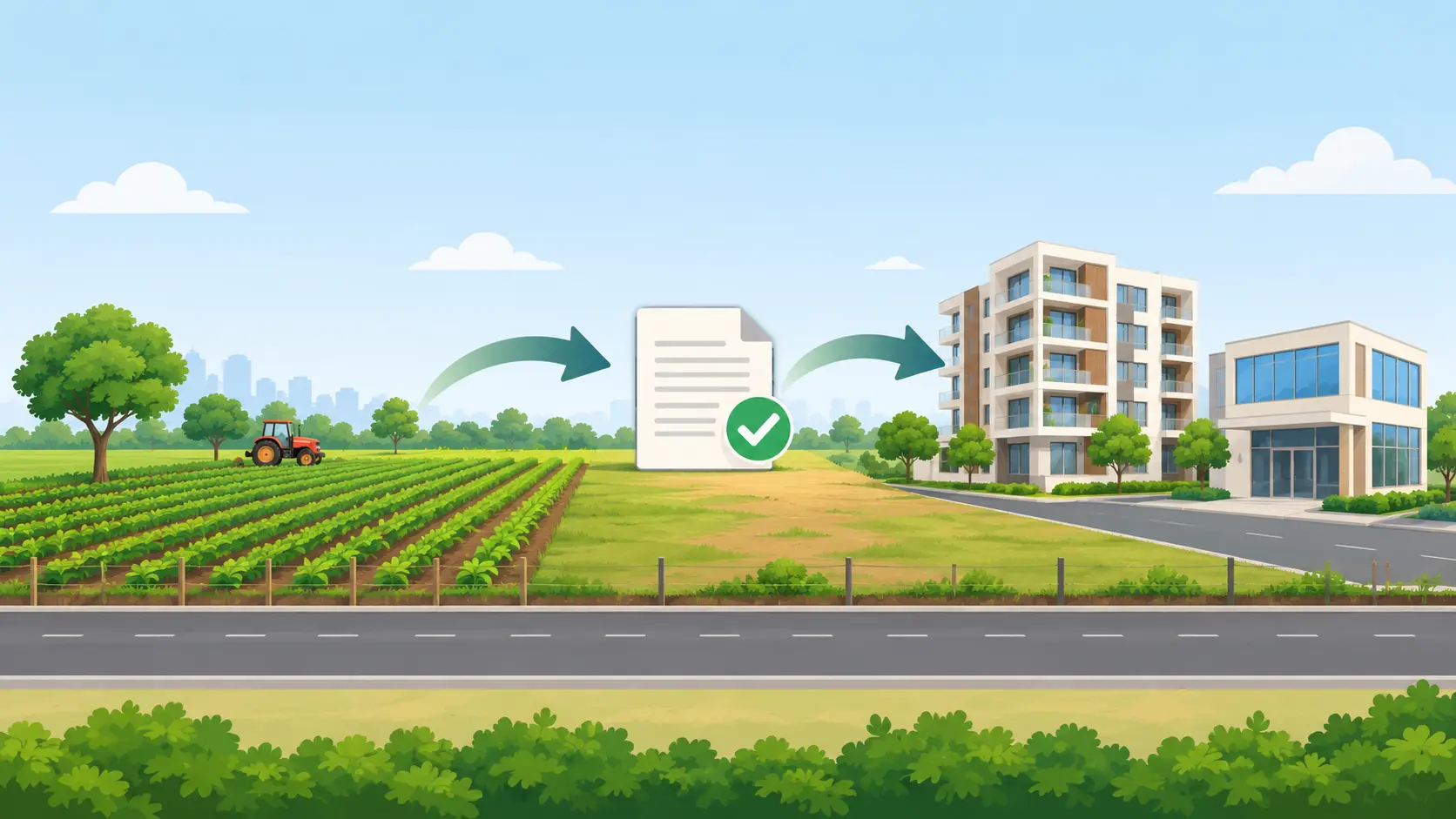
DC conversion, also called land conversion or land-use change, is the process of changing agricultural land to non-agricultural (residential, commercial or industrial) use under the Karnataka Land Revenue Act. It is generally needed before a building plan can be approved on that land. DC stands for Deputy Commissioner.
Many people discover DC conversion only when a building plan is refused or a bank asks for the conversion order. By then, weeks have been lost. This guide explains what DC conversion is, who needs it, the steps, the documents, what decides the charges, and what to do next. It also explains what DC conversion consultants, land conversion consultants and land use change consultants actually do, so you can decide how much help you need.
1. What is DC conversion?
DC conversion is the legal change of a piece of land from agricultural use to non-agricultural use. In Karnataka, agricultural land is recorded as such in the land records, mainly the RTC (Record of Rights, Tenancy and Crops, also called pahani). You cannot build a house, shop, godown or factory on land recorded as agricultural without first changing its use.
The change is made under Section 95 of the Karnataka Land Revenue Act, 1964. Traditionally the Deputy Commissioner (DC) issued the conversion order, which is why the process is called DC conversion. Recent reforms have changed who decides and how fast in some cases, but the end result is the same: the land is recorded as non-agricultural for the approved use.
2. DC conversion, land conversion and land use change: are they the same?
In everyday use, yes. These terms all describe the same process.
It is not the same as B-Khata to A-Khata conversion. That is a different process about the khata record of a property. See Section 13.
3. Who needs DC conversion?
- Owners who want to build a home, shop or office on agricultural land.
- Buyers of agricultural plots, who should check the land use before they pay.
- Layout developers and builders planning residential or commercial projects.
- Businesses setting up a warehouse, godown or factory on agricultural land.
- Families dividing or selling inherited agricultural land for non-agricultural use.
If your RTC already shows the land as non-agricultural, or the land has an earlier conversion order for the same use, you may not need to convert again. A document check will tell you.
4. When you may not need DC conversion, or may not get it
Rules differ by location and by the master plan. In general:
- Land already recorded as non-agricultural may not need conversion.
- Reports on the 2025 amendments say that, in some cases, land inside an approved master plan zone for the intended use can be converted through the planning authority without the Deputy Commissioner's prior permission. Check the current rules for your land.
- Land in zones where the intended use is not allowed, such as a green belt or an agricultural zone, can be refused conversion.
- Land with conditions on transfer or use, such as granted land, may have extra restrictions.
- Land under dispute, or with missing or mismatched records, can be delayed or refused.
Check zoning and records before you buy or apply. Our property document verification service can do this for you.
See property document verification and our legal services for title checks.
5. Land conversion consultants: what they do
Land conversion consultants manage the paperwork and follow-up for you. A good consultant will:
- Check the RTC, mutation, title documents and the land's history.
- Check the zoning and whether the intended use is allowed.
- List the documents you need and help get the ones that are missing.
- Prepare and file the application and affidavit.
- Follow up with the offices, answer queries and track the application.
- Guide you on the next step: plan approval, khata and tax.
A consultant cannot guarantee the result, because the decision rests with the authority. What a consultant can do is avoid mistakes that cause delay.
6. DC conversion consultants in Bangalore: how to choose one
Ask these questions before you hire anyone.
- Will you check my documents and zoning before you quote?
- What exactly is included: documents, application, follow-up, the final order?
- What are the government fees, and what is your professional fee? Are they shown separately?
- Who will be my contact, and how will I be updated?
- What happens if the land cannot be converted?
- Do you help with the building plan after conversion?
Be careful of anyone who guarantees conversion, quotes without seeing the documents, or asks for payment with no written scope.
Marvel Consultants helps owners and developers with property documents and approvals in Bangalore. See our BBMP plan approval support for what comes after conversion.
7. Land use change consultants: checking the master plan and zoning
Before the application, the first question is whether your land can be converted for the use you want. The answer comes from the master plan and the zoning rules for your location, and from any local restrictions. Land inside the Bengaluru limits, in the BDA or BMRDA areas, or under a local body may follow different master plans and planning authorities.
A land use change consultant reads the zoning extract and tells you what is allowed. This avoids buying or applying for land that cannot be used for your plan.
8. The DC conversion process, step by step
The exact steps can vary with the rules in force and the location. This is the general flow.
Step 1: Check the land
Check the RTC, mutation, title documents, survey details and the zoning. Fix mismatches before applying.
Step 2: Collect the documents
Gather the documents listed in Section 9. Missing records are the most common cause of delay.
Step 3: Prepare the application and affidavit
The application is filed with the details of the land and the intended use, along with an affidavit in the prescribed form.
Step 4: File the application
File the application through the route that applies to your land. Reports say much of the process is now online, but check the current system.
Step 5: Scrutiny and opinions
The authority checks the application and may seek opinions from other departments. Queries need quick, accurate answers.
Step 6: Pay the conversion fee
The prescribed fee is paid when the authority asks for it. The amount depends on the land use and location. Keep the receipt.
Step 7: Receive the conversion order or certificate
The authority issues the order or certificate. Check the survey number, extent, owner name and the approved use.
Step 8: Update the land records
Make sure the RTC and other records show the change. Keep several copies of the order.
9. Documents commonly needed for DC conversion
The list varies by case. Commonly asked for:
- RTC (record of rights) extract for the survey number
- Mutation register extracts
- Title documents such as the sale deed, gift deed or partition deed
- Survey sketch or land sketch
- Affidavit in the prescribed form, notarised
- Identity and address proof of the owner
- Tax paid receipts and, where relevant, khata papers
- Master plan or zoning extract for the location
- Earlier conversion orders or layout approvals, if any
- Power of attorney, if someone else is applying
Not sure what you have? See our property documentation support or send photos of your documents on WhatsApp.
10. DC conversion charges: what decides them
Many people search for DC conversion charges in Bangalore. We do not quote figures here, because the fee is set by the government, depends on the case and is revised from time to time. The main factors are:
Ask for a written breakup that shows the government fee and the professional fee separately.
11. How long does DC conversion take?
There is no single answer. The time depends on the type of land, the completeness of your documents, how many departments give opinions and the rules in force. The law sets time limits for decisions, and reports on the 2025 changes mention deemed approval in some cases if the authority does not act in time. These rules have been revised, so do not rely on any fixed number of days. Ask for the current position, and allow extra time for queries.
12. After conversion: what comes next
- Check that the land records show the new use.
- If you are making sites, a layout approval may be needed.
- For a building, apply for plan sanction with the conversion order.
- Apply for the khata and pay the property tax as required.
- After construction, you will need the Commencement and Occupancy Certificates.
Plan approval is the natural next step. See our BBMP plan approval support and our owner build journey. For developers, see project compliance liaison. For khata, see e-Khata services.
13. DC conversion and B-Khata to A-Khata conversion
Many readers search for 'DC conversion charges for B to A khata'. These are two different things.
A site formed on agricultural land without conversion may end up on B-Khata. Whether conversion records matter for upgrading the khata depends on the case. Have your documents checked before you decide.
Read our guide to B-Khata to A-Khata conversion or see the B-Khata to A-Khata conversion service.
14. Common problems and mistakes
- Buying agricultural land without checking whether it can be converted.
- Starting construction before the conversion order is issued.
- Mismatch in names, survey numbers or extent between the documents.
- Incomplete or outdated RTC and mutation records.
- Assuming that conversion also gives plan approval or an A-Khata. It does not.
- Using converted land for a different purpose from the one approved.
- Paying a consultant with no written scope or fee breakup.
How Marvel Consultants can help
Marvel Consultants has helped property owners and developers in Bangalore with documents, khata and approvals for over ten years. We can check your land documents, explain what applies to your land and support you through the steps. When you are ready to build, we also help with BBMP plan approval. To start, send your RTC on WhatsApp or contact us.
Frequently asked questions
What is DC conversion in Bangalore?
DC conversion is the legal change of land use from agricultural to non-agricultural, such as residential, commercial or industrial. DC stands for Deputy Commissioner, the officer who has traditionally issued the conversion order. It is governed by the Karnataka Land Revenue Act, 1964, and the process has been revised more than once, so always check the current rules.
Is DC conversion the same as land conversion and land-use change?
In everyday use, yes. People say DC conversion, land conversion, land-use change, change of land use and agricultural to non-agricultural conversion for the same process. The order or certificate that records the change is what you need for building and for clean land records.
Who needs DC conversion?
Anyone who wants to use agricultural land for a non-agricultural purpose needs it. That includes owners building a home on agricultural land, buyers of agricultural plots, layout developers and businesses setting up on such land. If your land is already recorded as non-agricultural, you may not need it.
Is DC conversion required before building plan approval?
Generally yes. The planning authority, such as BBMP or the Greater Bengaluru Authority, BDA, BMRDA or the local body, usually asks for proof that the land is non-agricultural before it sanctions a building plan. The exact requirement depends on the land and its zone.
What documents are needed for DC conversion?
Commonly an RTC (record of rights) extract, mutation extracts, title and sale deed documents, a survey sketch, an affidavit in the prescribed form, identity proof, tax receipts, and a master plan or zoning extract. Khata papers may be asked for if the land is under a local body. The list varies by case, so confirm it before you apply.
How long does DC conversion take?
It varies by case and has changed with recent reforms. The law sets time limits for decisions, and reported changes include deemed approval in some cases if the authority does not act in time. Do not rely on a fixed number of days. Ask for the current position, and allow extra time for queries and document corrections.
What are the DC conversion charges in Bangalore?
The conversion fee is set by the government and depends on factors such as the land use, location and zone. It is revised from time to time, so we do not quote figures here. Ask for the current fee from the authority or from us. Professional fees are separate and depend on the case.
Is DC conversion needed for B-Khata to A-Khata conversion?
They are different processes. B-Khata to A-Khata conversion upgrades the khata record of a property. DC conversion changes the land use of agricultural land. If your B-Khata site was formed on agricultural land, whether conversion records matter depends on the case, so have your documents checked.
Can all agricultural land be converted?
No. The zone in the master plan, restrictions such as green belt or granted-land conditions, disputes, and missing records can all stop or delay conversion. Check the zoning and the land's history before you buy or apply.
What happens if I build on agricultural land without conversion?
The construction can be treated as unauthorised, plan approval can be refused, and the owner can face notices and penalties. It can also create problems for khata, loans and resale. It is better to complete the conversion first.
Related guides
B-Khata to A-Khata conversion in Bangalore: complete guide
e-Khata online in Bangalore and Karnataka: complete guide
BBMP property tax assessment and payment
Disclaimer: This guide is general information, not legal advice. Land conversion rules in Karnataka change, and the rules for your land depend on its location, zone and records. Check the current rules and your documents before you act. Marvel Consultants is a private consultancy and is not affiliated with BBMP, BDA or any government authority.